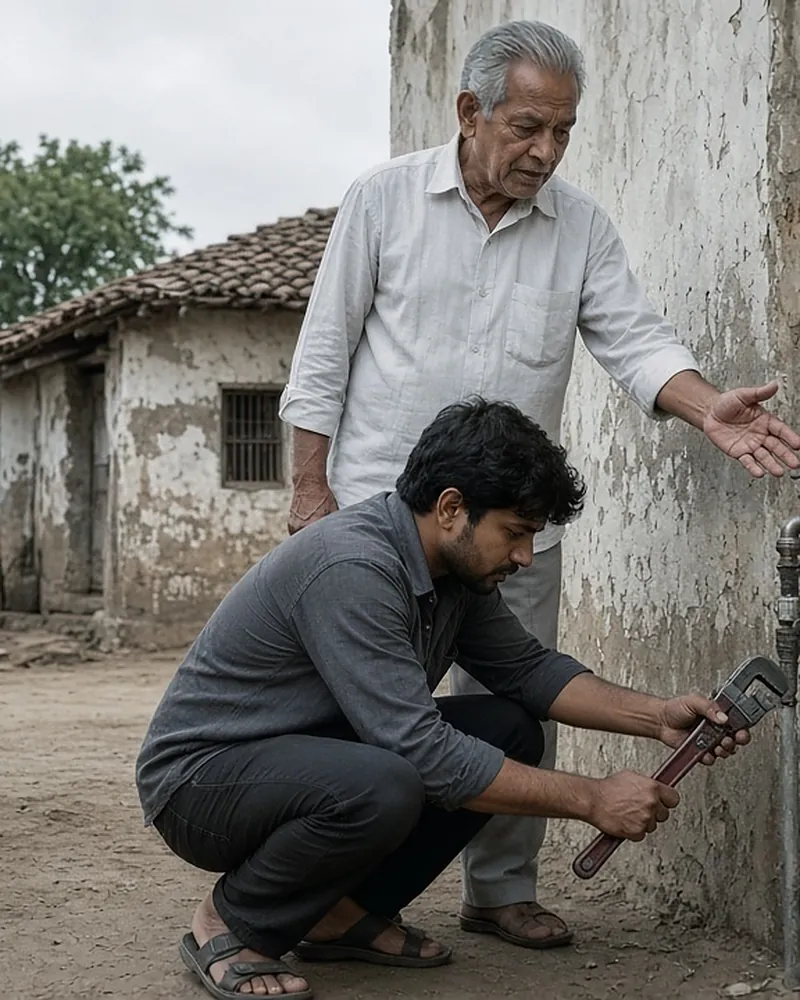
Your tap has gone dry. Water comes once a week instead of daily. A pipe has burst in the lane. The water smells. Or your home was simply left out. These are all real Jal Jeevan Mission problems, and government routes exist to get them fixed.
The key fact to remember is that drinking water is a State subject. The Centre funds and monitors the mission, but States plan, build, run and maintain schemes, and after handover the village Pani Samiti runs the system day to day. So most complaints are solved fastest locally, and the national route exists mainly to push a stuck complaint back to the State. The “Start with the right level” table names the first contact for each problem.
Start with the right level
| Problem | Go first to | If not solved |
|---|---|---|
| Tap dry, low pressure, irregular timings | Pani Samiti / Nal Jal Mitra | Block or district water office |
| Leak or broken pipe in the village | Pani Samiti | Block or district water office |
| Dirty, smelly or unsafe water | Pani Samiti; Citizen Corner | District water quality lab / department |
| Home left out of the scheme | Pani Samiti; Gram Sabha | District office; CPGRAMS |
| Poor-quality works by contractor | Gram Panchayat | District office; CPGRAMS |
| Water charge or accounts question | Pani Samiti | Gram Sabha; district office |
Problems the Pani Samiti can fix
Under JJM 2.0, the Gram Panchayat and its Village Water and Sanitation Committee are responsible for day-to-day operation and maintenance of the village scheme, including infrastructure upkeep, water quality monitoring, records and grievance redressal. The guidelines specifically give the VWSC the job of recording, tracking and helping to resolve consumer complaints at local level.
Many villages have a Nal Jal Mitra, a trained local technician engaged by the VWSC, who can open valves, fix small leaks, look after pumps and report bigger faults to the District Technical Unit. So for most everyday problems, the quickest route is a direct word with the Pani Samiti or Nal Jal Mitra, followed by a written note if it is not fixed.
You can also raise problems in the Gram Sabha. Under JJM 2.0 the Gram Panchayat facilitates an annual functionality check, Jal Seva Aankalan, and presents the findings village by village in the Gram Sabha for public discussion and corrective action.
District and State water department
If the village level cannot fix it, go to your State’s rural water supply or Public Health Engineering (PHE) department, starting with the office of the Junior Engineer, Assistant Engineer or Executive Engineer that covers your block or district. In each district the District Water and Sanitation Mission, headed by the District Collector, oversees the mission, and the Executive Engineer of the water department is its member-secretary.
Several States run their own Jal Jeevan Mission helplines, complaint portals or apps. Numbers and portals differ from State to State and change from time to time, so use the contact listed on your State water department’s official website, or the State toll-free number shown in the Citizen Corner. Be careful with numbers found on non-government websites or social media.
The Citizen Corner for water quality
The Citizen Corner on the JJM Dashboard shows village-level water quality results, helps you find the nearest testing lab and its rates, and lets you raise a water quality concern through an online complaint form or your State’s toll-free number. If water quality in your village is outside limits, the complaint is brought to the attention of the district’s water supply department. Visit the Citizen Corner.
CPGRAMS: the central grievance portal
If you have tried locally and the problem is still not fixed, you can lodge a grievance on the Centralised Public Grievance Redress and Monitoring System (CPGRAMS) at pgportal.gov.in. Choose the Ministry of Jal Shakti, Department of Drinking Water and Sanitation.
The Government told Parliament in March 2025 that complaints received at Centre level through CPGRAMS, the Department’s website and physical channels are transferred to the water supply department of the State concerned for timely redressal. In other words, CPGRAMS will not send an engineer from Delhi, but it creates a tracked record and pushes the State to respond. (PIB, 17 March 2025)
CPGRAMS asks you to register and gives you a registration number to track your grievance. Use only the official site at pgportal.gov.in.
National Jal Jeevan Mission contact
For policy questions, or to report something serious that is not being addressed, the National Jal Jeevan Mission publishes this contact:
| Item | Detail |
|---|---|
| Office | Mission Director, National Jal Jeevan Mission, DDWS, Ministry of Jal Shakti |
| Address | 4th Floor, Pandit Deendayal Antyodaya Bhawan, CGO Complex, Lodhi Road, New Delhi-110003 |
| Phone | 011-24362705 |
| [email protected] |
Source: jaljeevanmission.gov.in (contact footer).
This is an office line, not a 24-hour helpline for individual leaks or supply cuts. Those are handled by your State.
What to include in a complaint
A clear complaint is resolved faster. Include:
- Where: State, district, block, Gram Panchayat, village or hamlet, and ward or landmark.
- What: no water, irregular supply, low pressure, leak, broken pipe, dirty water, smell, home not connected, damaged road after pipe work.
- Since when: the date the problem started, and how often it happens.
- Who you told: dates you informed the Pani Samiti or department, and any complaint number.
- Evidence: a photo of the leak or dry tap, or a water test report if you have one.
- How to reach you: give a contact number only on the official portal or to the department.
Never share an OTP, bank PIN or card details to register a water complaint.
Water quality complaints
If you suspect contaminated water:
- Stop drinking it if it looks, smells or tastes wrong, and use a safe alternative.
- Ask the trained women in your village to test it with a Field Test Kit, or check the Citizen Corner for recent results.
- A bad kit result must be confirmed in a lab. States are required to act on confirmed contamination, for example by disinfecting, fixing the source, providing an alternative safe source or installing treatment.
- If nothing happens, complain through the Citizen Corner route, the State department, then CPGRAMS.
See Water quality testing for limits and labs.
Keep a simple record
Complaints move faster when there is a paper trail. Keep a small note of:
| Record | Why it helps |
|---|---|
| Date you first reported the problem | Shows how long it has gone unresolved |
| Name or role of the person you told | Lets the department follow up |
| Complaint or registration number | Needed to track on a portal or CPGRAMS |
| Photos with dates | Shows the leak, dry tap or dirty water |
| Water test report | Supports a quality complaint |
If you escalate, attach or quote this record so the officer does not have to start from scratch.
A short written complaint might read: “Our tap in Ward 4, near the school, has had no water since 3 November. We told the Pani Samiti on 5 November. Please restore supply.” Add your village, Panchayat, block and district at the top.
Avoid fake helplines
Fraudsters copy the names of popular schemes. Be careful if someone:
- asks for money to “register” a complaint or a new connection;
- asks for an OTP, UPI PIN or bank details;
- sends a link to a site that is not a government (.gov.in or .nic.in) address;
- claims to be from “Jal Jeevan Mission head office” and offers a tap, job or certificate for a fee.
Registering a grievance on CPGRAMS and the State portals is free.
For problems getting a new connection, see How to get a tap connection. For the Pani Samiti’s duties, see Pani Samiti (VWSC). For what a working tap should provide, see FHTC.
FAQ
What is the Jal Jeevan Mission complaint number?
There is no single national toll-free number for supply complaints. States run their own helplines. Use the number on your State water department’s official site or the Citizen Corner. The National Jal Jeevan Mission office line is 011-24362705.
Where can I file a Jal Jeevan Mission complaint online?
Use your State’s official JJM or PHE portal, the Citizen Corner for water quality, or CPGRAMS at pgportal.gov.in. CPGRAMS complaints are forwarded to the State water department.
Who is responsible for repairing a broken tap or pipe?
After handover, the Gram Panchayat and Pani Samiti handle day-to-day repairs, often through a Nal Jal Mitra. Major repairs are supported by the district and State water department.
My village is Har Ghar Jal but I get no water. Where do I complain?
Tell the Pani Samiti in writing, raise it at the Gram Sabha, and escalate to the block or district water office and then CPGRAMS.
Is there a fee to register a complaint?
No. Filing a complaint on CPGRAMS or a State portal is free.
How do I complain about water quality?
Use the Citizen Corner on the JJM Dashboard, which offers an online form or your State’s toll-free number, or ask the Pani Samiti for a test.