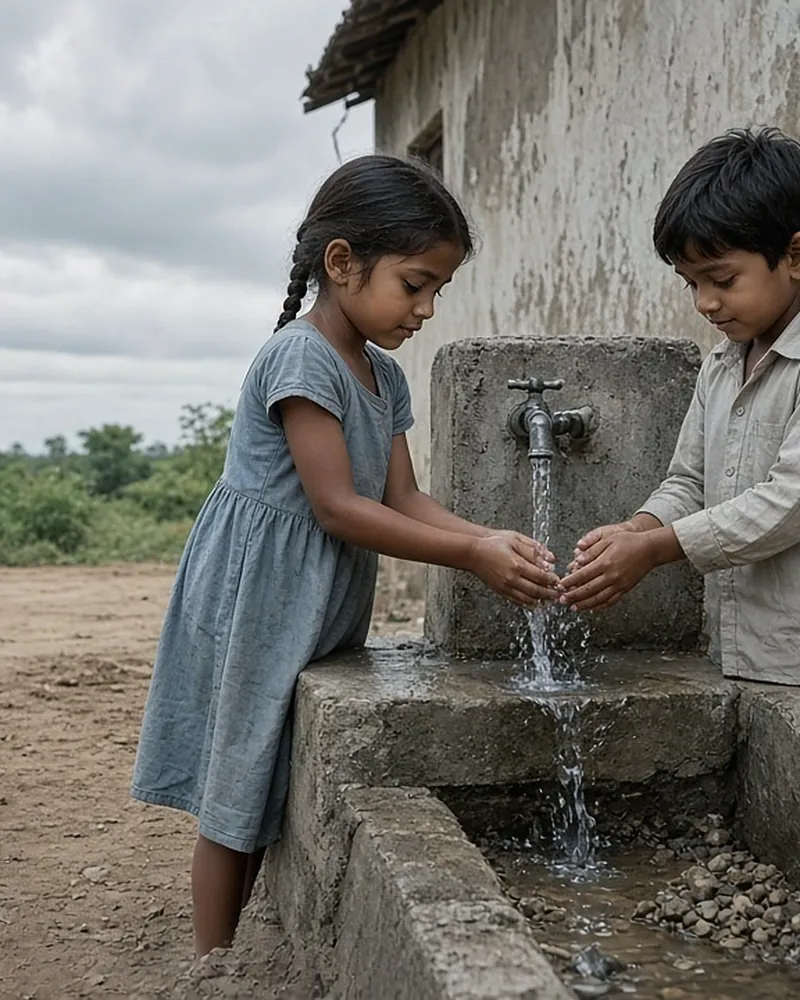
A tap in every home is only one part of a healthy village. Water has to come from somewhere, it has to be kept clean, and once used it has to go somewhere safe. That is why Jal Jeevan Mission is designed to work alongside other government programmes, especially Swachh Bharat Mission (Grameen) for sanitation, which is run by the same department.
Why water and sanitation are planned together
Both Jal Jeevan Mission and Swachh Bharat Mission (Grameen) sit in the Department of Drinking Water and Sanitation, Ministry of Jal Shakti. The link is practical:
- More piped water in homes means more used water from kitchens and bathrooms, which needs safe disposal.
- Toilets and drains that leak can contaminate wells and pipelines, so sanitation protects water quality.
- Both rely on the same village institutions: the Gram Panchayat and its Village Water and Sanitation Committee.
The JJM components explicitly include greywater management, and the mission’s guidelines ask States to combine funds from different schemes wherever possible. In the words of the mission, convergence is key.
Swachh Bharat Mission (Grameen)
Swachh Bharat Mission (Grameen), or SBM(G), was launched on 2 October 2014 to make rural India open defecation free (ODF) by providing toilets for all rural households.
| Phase | What it did |
|---|---|
| Phase I (2014–15 to 2019–20) | More than 10 crore household toilets built; States/UTs declared ODF on 2 Oct 2019 |
| Phase II (2020–21 to 2026–27) | Sustain ODF and make villages ODF Plus with solid and liquid waste management |
Source: PIB, 9 March 2026.
Progress reported by States and UTs on SBM(G)‘s system, as on 22 January 2026:
| Measure | Figure |
|---|---|
| Villages declared ODF Plus (Model) | 4,94,301 of 5,86,944 (84%) |
| Household toilets built since 2014 | 12.03 crore |
| Community sanitary complexes | 2.68 lakh |
| Villages with solid waste management | 5.28 lakh |
| Villages with liquid waste management | 5.45 lakh |
Source: PIB, 9 March 2026.
The budget estimate for SBM(G) in 2026–27 is ₹7,192 crore, compared with ₹67,670 crore for Jal Jeevan Mission. For SBM(G) details and its own complaint routes, visit the official Swachh Bharat Mission (Grameen) portal.
Greywater management
Greywater is the used water from a household’s kitchen, bathing and laundry. It does not include toilet waste, which is called blackwater. The JJM 2.0 guidelines define greywater management as its collection, treatment and safe reuse.
Without it, water from new taps can pool in lanes, breed mosquitoes and seep into sources. Typical village solutions include soak pits for individual homes, community soak pits and simple treatment systems that allow reuse for gardens or recharge. Greywater management is a component of Jal Jeevan Mission and also part of liquid waste management under SBM(G) Phase II, which is why the two schemes plan it together with the Gram Panchayat.
Finance Commission tied grants
The Central Finance Commission gives grants to rural local bodies (Panchayats), and part of these are tied to drinking water and sanitation. Under Jal Jeevan Mission they are one of the sources a Gram Panchayat or VWSC can use for operation and maintenance, alongside water charges and the mission’s incentive funds. The Government has also told Parliament that 15th Finance Commission tied grants can be used, in convergence, for source recharge and water conservation. (PIB, 17 March 2025)
MGNREGS and source sustainability
A tap is only as reliable as the source behind it. Jal Jeevan Mission asks States to strengthen sources through bore well recharge structures, rainwater recharge, reviving existing water bodies and reusing greywater, in convergence with:
- the Mahatma Gandhi National Rural Employment Guarantee Scheme (MGNREGS), which can pay for village water conservation works;
- the Integrated Watershed Management Programme;
- 15th Finance Commission tied grants to Panchayats;
- State schemes and CSR funds;
- the Jal Shakti Abhiyan: Catch the Rain campaign, launched in 2019, which took up “Source Sustainability for Drinking Water” as its theme in 2023.
Source: PIB, 17 March 2025.
Nal Jal Mitra Programme
To keep village schemes running, the Department runs the Nal Jal Mitra Programme, which trains local people, preferably youth or ex-servicemen, to operate and maintain village water systems and do minor repairs. A trained Nal Jal Mitra can be engaged by the VWSC. See Pani Samiti (VWSC).
Schools, anganwadis and public buildings
Jal Jeevan Mission’s objectives go beyond homes. The mission also aims to provide tap water to schools, anganwadi centres, Gram Panchayat buildings, health centres, wellness centres and community buildings. This links the mission with education, child development and health programmes run by other ministries, because a school or anganwadi with a working tap can also keep toilets clean and children can wash their hands. A village is reported as Har Ghar Jal only when the State water department confirms that all homes, schools and anganwadi centres have tap water, and the official JJM Dashboard has a separate view for tap water in schools and anganwadis. See Har Ghar Jal certification.
AMRUT for urban areas
Jal Jeevan Mission is for rural households. Water supply in towns and cities is the job of municipal bodies, supported by the Ministry of Housing and Urban Affairs through its urban mission, AMRUT. If you live in a town, contact your municipal corporation or council, and see the official AMRUT portal.
Water quality and health
Clean water and safe sanitation work together for health. The Government’s March 2026 Cabinet release cited a World Health Organization estimate that the mission could prevent about 4 lakh deaths from diarrhoeal disease, a benefit that depends on both safe water and safe disposal of human waste. That is why toilets, drains and soak pits are planned alongside taps.
Water quality testing under Jal Jeevan Mission also involves anganwadi workers and ASHAs, who are among the five people trained in each village to use Field Test Kits. See Water quality testing.
Comparison at a glance
| Scheme | Main aim | Run by |
|---|---|---|
| Jal Jeevan Mission | Tap water in every rural home | DDWS, Ministry of Jal Shakti |
| SBM (Grameen) | Toilets, ODF Plus, waste management | DDWS, Ministry of Jal Shakti |
| MGNREGS | Rural jobs; water conservation works | Ministry of Rural Development |
| Finance Commission grants | Panchayat funds incl. water and sanitation | Ministry of Finance via States |
| AMRUT | Urban water supply and sewerage | Ministry of Housing and Urban Affairs |
What this means for your village
When your Gram Panchayat plans its water supply, it should also be planning soak pits or drains for greywater, protecting the source from toilets and waste, and looking at recharge works under MGNREGS. The Gram Sabha is where these plans come together, and the Pani Samiti is often the same committee that looks after sanitation. For how a household gets a tap, see How to get a tap connection. For the mission’s aims, see What is Jal Jeevan Mission?. For the 2026 changes, see Jal Jeevan Mission 2.0. Common questions are on the FAQ.
FAQ
What is the difference between Jal Jeevan Mission and Swachh Bharat Mission?
Jal Jeevan Mission provides tap water to rural homes. Swachh Bharat Mission (Grameen) provides toilets and village waste management. Both are run by the Department of Drinking Water and Sanitation.
Is greywater management part of Jal Jeevan Mission?
Yes. It is one of the mission’s components and also part of liquid waste management under SBM(G) Phase II.
Can MGNREGS be used for Jal Jeevan Mission works?
MGNREGS can be used, in convergence, for water conservation and source recharge works that make village water sources more reliable.
Does Jal Jeevan Mission cover cities?
No. Cities and towns are covered by municipal bodies and the Ministry of Housing and Urban Affairs’ urban mission, AMRUT.
What is ODF Plus?
A village that sustains open defecation free status and also has arrangements for solid and liquid waste management, under SBM(G) Phase II.