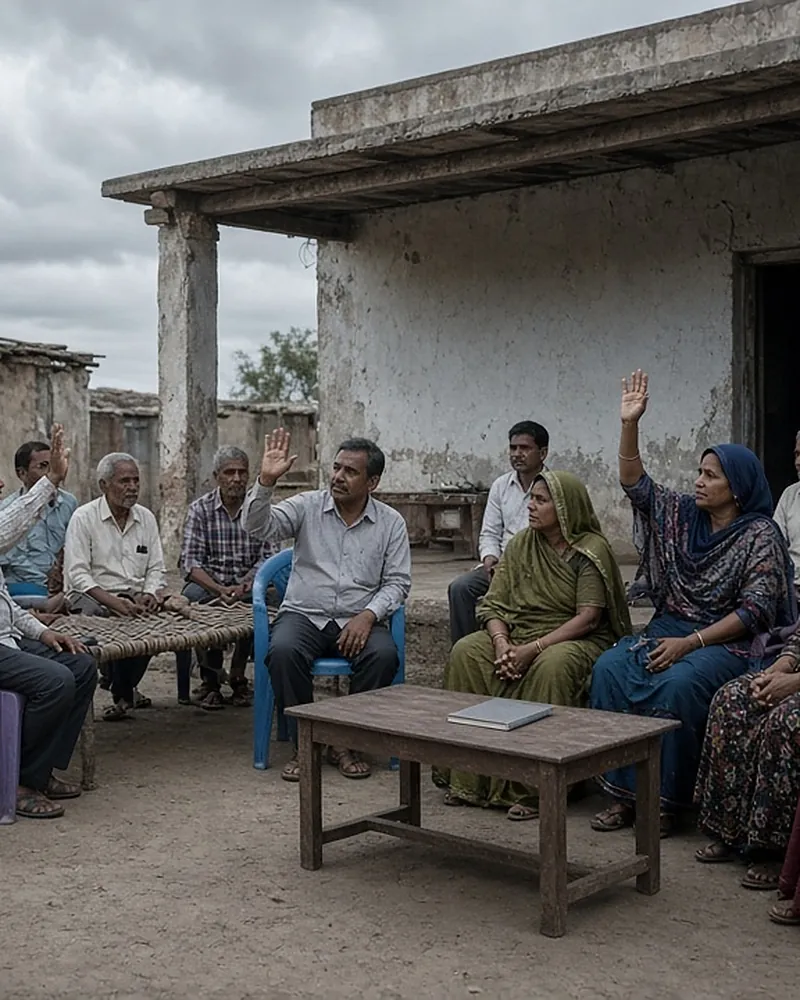
“Har Ghar Jal” is the mission’s tagline, but it is also an official status. A village, Panchayat, block, district or even a whole State becomes “Har Ghar Jal” when every household in it has tap water. Getting there involves three stages, and the last one is decided not by an engineer but by the village itself, in the Gram Sabha.
What Har Ghar Jal status means
The official JJM Dashboard describes it simply: Har Ghar Jal means all households in that administrative unit are provided with tap water supply.
The JJM 2.0 Operational Guidelines give a fuller definition. Har Ghar Jal certification is a formal certification given to a Gram Panchayat or village where every rural household has a Functional Household Tap Connection supplying potable water at a minimum of 55 litres per person per day, of quality conforming to BIS IS:10500, on a regular basis. In other words, it is meant to confirm working taps, not just pipes. See FHTC for the three tests.
The three stages
| Stage | Name | What happens |
|---|---|---|
| 1 | 100% tap connection | Every home with a tap is entered in JJM IMIS after verifying the head of household’s name and Aadhaar number |
| 2 | Reported | The State water department confirms water reaches all homes, schools and anganwadis |
| 3 | Certified | The Gram Sabha passes a resolution confirming the department’s claim |
Source: “About Har Ghar Jal”, JJM Dashboard.
Stage 1 – village with 100% tap connection. Households that have been given a tap are recorded on the mission’s management information system (IMIS) after the name and Aadhaar number of the head of household are verified by the implementing department. When every household in the village is recorded, the village is shown as having 100% tap water connections. This verification is done by the government department in the village; it is not something households do online.
Stage 2 – Reported. The State’s water supply department confirms that water is actually being supplied through taps to all households, schools and anganwadi centres in the village. The village then appears as “Har Ghar Jal reported”.
Stage 3 – Certified. The water supply department gives the Gram Panchayat a certificate declaring that all households have tap water. The Gram Sabha then checks that claim and, if satisfied, passes a resolution. Only then is the village “Har Ghar Jal certified”.
The Gram Sabha resolution
The Gram Sabha is the meeting of all adult voters of the village. Making it the final step is deliberate: the people who use the taps decide whether the claim is true.
If you attend a Gram Sabha where Har Ghar Jal certification is on the agenda, it is reasonable to ask:
- Does every household, including those at the edges of the village and in new hamlets, have a tap?
- Does water come regularly, at the scheduled times?
- Is the quantity enough for the household?
- Has the water been tested, and are the results available?
- Do the school and anganwadi have working taps?
- Who will run and repair the system, and what will the monthly water charge be?
If the answer to any of these is no, the Gram Sabha can raise it before passing the resolution. You can check the published water quality results for your village in the Citizen Corner.
What changes under JJM 2.0
The Cabinet decision of 10 March 2026 that extended the mission to December 2028 added a key condition: a Gram Panchayat shall certify completion of works and declare itself Har Ghar Jal only upon confirmation that adequate in-village operation and maintenance mechanisms have been established by the State Government.
JJM 2.0 also introduces:
- Jal Arpan, the formal handover of a scheme to the Gram Panchayat and VWSC after a trial run of at least 15 days and verification, with a handover ceremony in front of the community.
- Jal Seva Aankalan, an annual functionality check facilitated by the Gram Panchayat, with results presented village by village in the Gram Sabha.
- Jal Utsav, an annual community event to check and maintain the system.
- A target to certify every Gram Panchayat in the country as Har Ghar Jal by December 2028.
Source: PIB, 10 March 2026; Operational Guidelines JJM 2.0. More on these on Jal Jeevan Mission 2.0.
Districts, blocks and States
The same idea scales up. A block, district or State is Har Ghar Jal when all of its villages are. The dashboard shows separate counts of reported and certified districts, blocks, Panchayats and villages, and certified units are also counted within the reported totals.
On 12 November 2026 the dashboard flagged seven States/UTs as certified Har Ghar Jal and four more as reported:
| Status | States/UTs |
|---|---|
| Certified | Goa, A&N Islands, DNH and DD, Haryana, Puducherry, Punjab, Arunachal Pradesh |
| Reported only | Telangana, Gujarat, Himachal Pradesh, Mizoram |
Source: JJM Dashboard, 12 November 2026.
National count of reported and certified villages
| Measure | 12 Nov 2026 |
|---|---|
| Villages on the dashboard | 5,86,165 |
| Villages reported Har Ghar Jal | 3,00,264 |
| Villages certified Har Ghar Jal | 2,17,994 |
| Certified as share of reported | about 73% |
Source: sum of the 34 States/UTs on the JJM Dashboard.
So a little over half of all villages were reported as Har Ghar Jal, and about three in four of those had completed Gram Sabha certification. The State-by-State village table is on State-wise coverage.
The “certificate download” question
People often search for a “Har Ghar Jal certificate download” or “certificate PDF”. It helps to know what the certificate actually is:
- It is a certificate issued by the State water supply department to the Gram Panchayat, followed by a Gram Sabha resolution. It is a village-level record, not a document issued to individual households.
- No household needs a Har Ghar Jal certificate to get a tap, to use water, or to claim any other benefit.
- Your village’s status is shown on the official JJM Dashboard and the Gram Panchayat holds the resolution. Ask the Panchayat Secretary if you want to see it.
Websites or agents that offer to “download your Har Ghar Jal certificate” for a fee, or ask for your Aadhaar number, OTP or bank details to do so, are not offering an official service.
If your village is certified but your home has no water
Certification records the position at one point in time. Homes can be missed, new homes are built, and systems break down. If your village shows as Har Ghar Jal but your home has no tap, no regular water, or unsafe water:
- Tell the Pani Samiti or Gram Panchayat in writing, and keep a copy.
- Raise it at the next Gram Sabha, especially during Jal Seva Aankalan or Jal Utsav.
- Contact the block or district office of your State’s rural water or Public Health Engineering department.
- If it is still not resolved, lodge a grievance on CPGRAMS. Complaints received by the Centre are forwarded to the State water department.
The full route is on Complaints, and the committee’s duties are on Pani Samiti (VWSC).
FAQ
What does Har Ghar Jal certified mean?
It means the State water department has certified that every home, school and anganwadi in the village has tap water, and the Gram Sabha has passed a resolution confirming it.
What is the difference between “reported” and “certified”?
“Reported” means the State water supply department has confirmed tap water in all homes, schools and anganwadis. “Certified” means the Gram Sabha has also passed a resolution accepting that claim.
How many villages are Har Ghar Jal certified?
On 12 November 2026 the dashboard showed 2,17,994 certified villages and 3,00,264 reported villages, out of 5,86,165.
Who issues the Har Ghar Jal certificate?
The State water supply department gives the certificate to the Gram Panchayat. The village becomes certified only after the Gram Sabha checks the claim and passes a resolution.
Do I need a Har Ghar Jal certificate for my house?
No. The certificate and resolution are village-level records. Individual households do not need one.
What changed in certification under JJM 2.0?
A Gram Panchayat may declare itself Har Ghar Jal only after the State confirms that in-village operation and maintenance arrangements are in place.