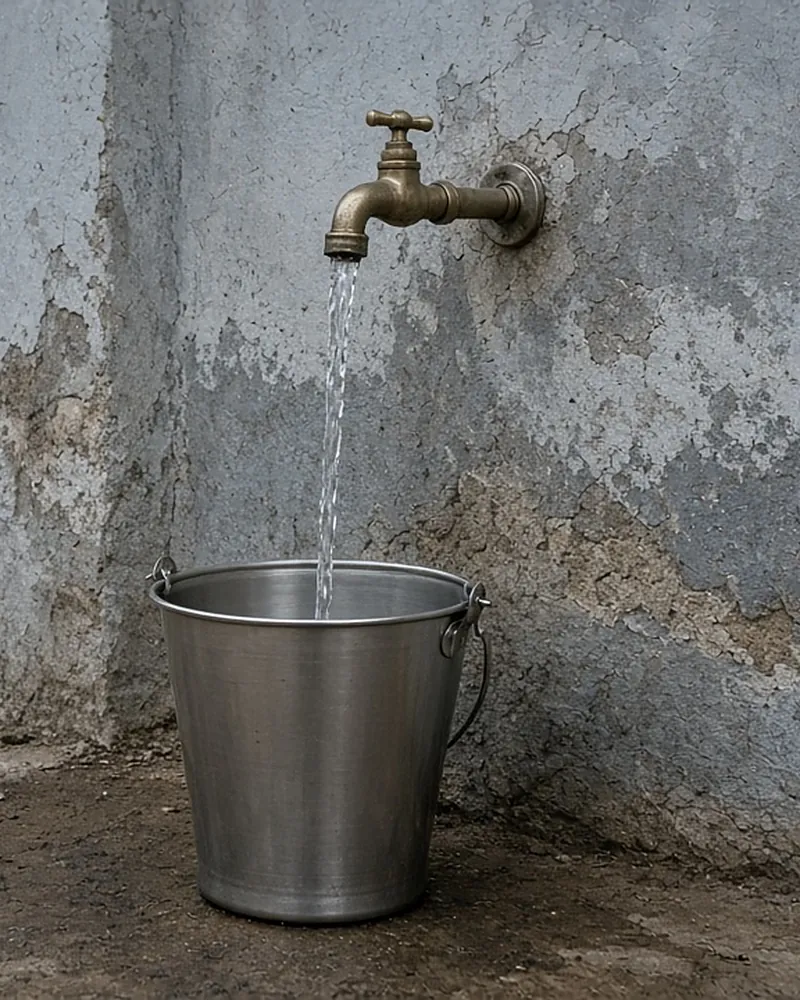
FHTC stands for Functional Household Tap Connection. It is the basic unit of Jal Jeevan Mission. Every target, every dashboard figure and every Har Ghar Jal certificate is built around it. But the word that matters most is the first one: functional. A tap that is fitted but dry, or that delivers dirty water, does not meet the standard.
FHTC full form and official definition
The Jal Jeevan Mission Operational Guidelines define an FHTC as:
A tap connection to a rural household for providing drinking water in adequate quantity of prescribed quality on regular basis.
They then define functionality: a tap connection is functional when it has the infrastructure (a household tap connection) providing water in adequate quantity, meaning at least 55 litres per capita per day (lpcd), of prescribed quality, meaning the BIS:10500 standard, on a regular basis, meaning continuous supply in the long term.
The JJM 2.0 guidelines of 2026 use the same standard when they define Har Ghar Jal certification: every rural home has an FHTC supplying potable water at a minimum of 55 lpcd, of quality conforming to BIS IS:10500, on a regular basis.
Sources: JJM Operational Guidelines (2019); Operational Guidelines JJM 2.0.
The three tests
| Test | Standard | What it means at home |
|---|---|---|
| Quantity | At least 55 lpcd | Enough water for drinking, cooking, bathing and cleaning |
| Quality | BIS:10500 | Safe to drink; no germs; chemicals within limits |
| Regularity | Regular, long-term supply | Water comes on schedule, week after week |
A tap passes only if it meets all three at once. That is why the official functionality figure is lower than the share of homes with a tap.
What 55 litres per person per day covers
The mission’s planners assume an average household of five people when estimating costs. At 55 lpcd, that works out as follows:
| Household size | Minimum water per day |
|---|---|
| 1 person | 55 litres |
| 3 people | 165 litres |
| 5 people | 275 litres |
| 8 people | 440 litres |
Source for the five-person assumption: JJM Financial Planning.
Fifty-five litres a person is a minimum service level, not a cap: it is the national floor for counting a tap as functional. If your household regularly gets far less than this, measured over a normal day, the tap is not meeting the standard and it is worth raising with the Pani Samiti.
A simple way to check is to note how long the supply runs and how many buckets or pots you fill, then multiply by their size. A 15-litre bucket filled 18 times is 270 litres, close to the 275-litre minimum for a family of five.
The older national programme counted water supply mainly in terms of habitations served by public sources such as handpumps and standposts. Jal Jeevan Mission raised the bar to a household tap and to 55 lpcd, and one of its components is retrofitting older schemes so they can reach this level.
BIS:10500 in plain words
BIS:10500 is the Indian Standard for drinking water, published by the Bureau of Indian Standards. Jal Jeevan Mission adopted it as the benchmark for water supplied through its schemes.
The standard sets two limits for many substances:
- An acceptable limit, which water should meet.
- A permissible limit that may be allowed only when no alternative source is available.
For some substances, such as arsenic, iron and nitrate, there is no relaxation. And for germs, the rule is absolute: total coliform and E. coli bacteria must not be detectable in any 100 ml sample.
Common examples are listed on Water quality testing, with the official acceptable and permissible limits.
Tap connection versus functional tap connection
The difference is not just wording. In 2024 the Department of Drinking Water and Sanitation had an independent third-party agency assess a statistical sample of villages. The results, reported to Parliament in March 2026, were:
| Finding (Functionality Assessment 2024) | Share |
|---|---|
| Homes in surveyed villages with a tap | 98.1% |
| Homes with taps that got water in the past week | 87% |
| Homes getting water on schedule | 84% |
| Homes getting at least 55 lpcd | 80% |
| Homes free from bacteriological contamination | 76% |
| Homes whose source was free of chemical contamination | 81% |
| Tap connections functional on all three tests | 76% |
Source: PIB, 9 March 2026.
So in the sample, almost every home had a tap, but roughly three in four connections were fully functional. The dashboard figure of 82.63% of rural homes with tap water (12 November 2026) counts connections reported by States. It does not by itself tell you whether each tap is meeting all three tests every day.
Schools, anganwadis and public buildings
FHTC is about households, but the mission’s objectives also include tap water for schools, anganwadi centres, Gram Panchayat buildings, health centres, wellness centres and community buildings. Har Ghar Jal “reported” status requires the State water department to confirm that water is reaching all homes, schools and anganwadi centres in the village. The JJM Dashboard has a separate view for tap water in schools and anganwadis.
How functionality is checked
Several checks run side by side:
- Third-party Functionality Assessments by independent agencies, using statistical sampling. Official reports are on the functionality reports page.
- Jal Seva Aankalan, an annual functionality check that the Gram Panchayat facilitates under JJM 2.0. Findings are presented village by village in the Gram Sabha.
- Monthly data from the VWSC on supply and complaints.
- Water quality testing by trained village women with Field Test Kits, and by laboratories (see water quality testing).
- Sensor-based monitoring of water supply, on a pilot basis in some villages.
- Third-party inspection of works before payments are made, and geo-tagging of assets.
Why the 55 lpcd standard matters for families
Before the mission, the main yardstick was a habitation getting at least 40 litres per person per day within about 100 metres, often from a public standpost or handpump. Moving to a tap at home and 55 lpcd changes daily life most for women and girls, who did most of the carrying. The Government’s own figures, citing outside studies, estimate that the mission has freed around 9 crore women from fetching water and could save 5.5 crore hours a day. Those gains depend on taps that work every day, which is why “functional” is in the name.
What to do if your tap is not functional
- Note the problem. No water, low pressure, irregular timings, a leak, a broken pipe, or water that looks, smells or tastes wrong.
- Tell the Pani Samiti or Gram Panchayat. Under JJM 2.0 they are responsible for day-to-day operation and maintenance, minor repairs and local complaints. A Nal Jal Mitra (village plumber-technician) may be able to fix it quickly.
- Ask for a water test if quality is the issue. Trained women in the village can screen it with a Field Test Kit, and any bad result should be confirmed at a lab.
- Escalate to the block or district office of your State’s rural water or Public Health Engineering department, and if needed through CPGRAMS.
The full route is on Complaints. To see how your State is doing overall, use State-wise coverage.
FAQ
What is the full form of FHTC?
Functional Household Tap Connection.
What does FHTC mean in Jal Jeevan Mission?
A tap connection to a rural household that supplies at least 55 litres per person per day of water meeting BIS:10500, on a regular and long-term basis.
What is 55 lpcd?
55 litres per capita per day, meaning 55 litres for each person in the household every day. For a five-person household that is 275 litres a day.
Is every tap connection counted as functional?
No. A tap is functional only if it meets the quantity, quality and regularity tests together. In the 2024 assessment, 76% of connections met all three.
Does FHTC include water for schools and anganwadis?
FHTC refers to households, but the mission also provides tap water to schools, anganwadi centres and other public buildings, and these are checked before a village is reported as Har Ghar Jal.
What is BIS:10500?
The Indian Standard for drinking water quality from the Bureau of Indian Standards, adopted by Jal Jeevan Mission as the quality benchmark.