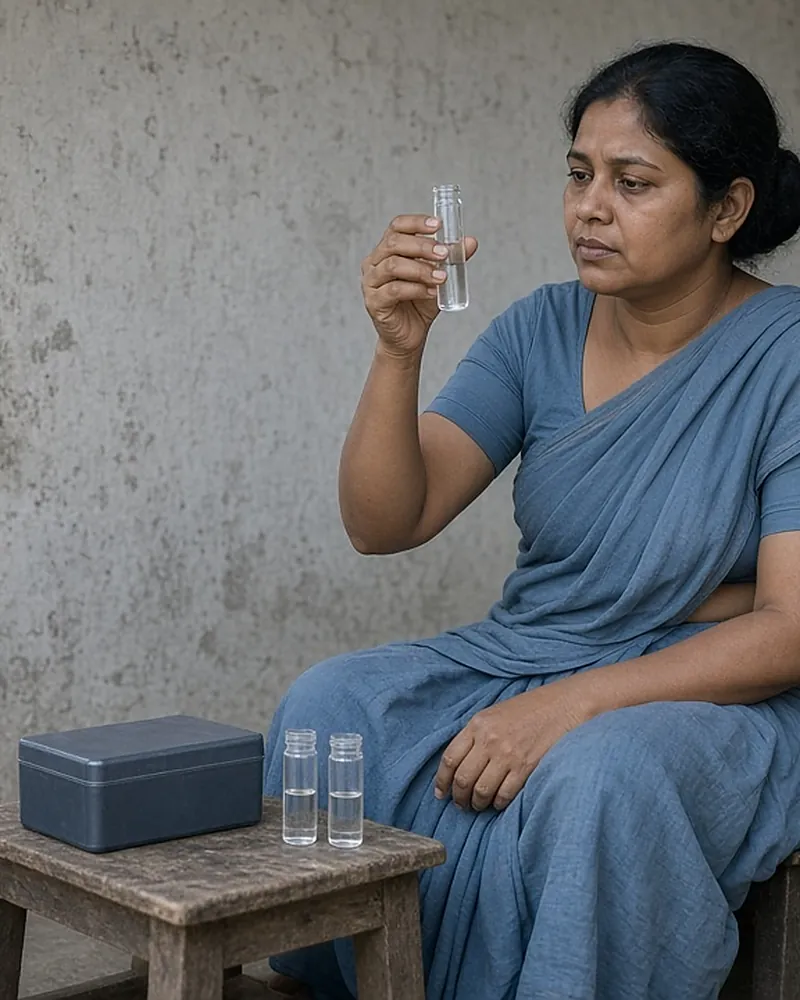
A tap is only useful if the water from it is safe to drink. That is why water quality is one of the three tests every Jal Jeevan Mission connection must pass, along with quantity and regularity. The mission has built a layered testing system: trained women in each village screen water with simple kits, a network of government laboratories confirms and analyses samples, and the results go into WQMIS, a public system that anyone can view.
Why testing is part of the mission
India’s groundwater contains natural contaminants in many areas, such as arsenic and fluoride, and water can also be contaminated by germs from sewage or by industrial pollution. Jal Jeevan Mission adopted the BIS:10500 drinking water standard as its benchmark and gives priority to villages with quality problems. One of the mission’s components pays for treatment and technology to remove contaminants, and water quality monitoring and surveillance is funded as a separate component, shared between the Centre and States.
In the 2024 Functionality Assessment, 76% of households were found free from bacteriological contamination and 81% of households’ supply sources were free from chemical contamination. Regular testing is how problems like these are found and fixed. (PIB, 9 March 2026)
The testing ladder
| Level | Who tests | How |
|---|---|---|
| Village | Five trained local people, preferably women | Field Test Kits and H₂S vials; sanitary inspection |
| Block / sub-division | State lab, including mobile labs | Lab analysis; confirms village results |
| District / regional | State lab | Full lab analysis |
| State | State referral lab | Advanced tests; oversight |
| Online | Village testers and laboratories | Results entered on WQMIS |
Sources: WQM&S Framework; PIB, 9 Feb 2026.
Field Test Kits and who uses them
A Field Test Kit (FTK) is a portable kit for checking drinking water on the spot. It needs no electricity and is designed to be simple to carry and use. Alongside it, H₂S vials show whether harmful bacteria are present: the water in the vial changes colour if they are.
States have been advised to identify and train five persons, preferably women, in every village. The water-quality framework suggests including the ASHA or local health worker, a Gram Panchayat or Pani Samiti member, a Self-Help Group member, and the anganwadi teacher or helper. They test water from sources and household taps, carry out sanitary inspections around sources and tanks, and upload the results to WQMIS.
What an FTK can check, according to that framework:
- turbidity (cloudiness), pH, total hardness, total alkalinity and chloride;
- residual chlorine, which shows whether disinfection is working;
- iron, nitrate and fluoride;
- arsenic, with a separate arsenic kit;
- bacteria, using the H₂S vial (presence or absence);
- ammonia and phosphate (optional).
Scale of village testing. As reported on WQMIS, about 24.80 lakh women had been trained to use FTKs by 12 March 2026. About 93.84 lakh samples were tested with FTKs in 2024–25, and about 47.59 lakh in 2025–26 up to 12 March 2026. Around 8 lakh of the trained women were actively updating their reports on the portal. (PIB, 16 March 2026; PIB, 12 Feb 2026)
FTK results are a first screening, not the final word. If a kit shows a problem, a sample must be sent to the nearest laboratory for confirmation using standard methods.
Sanitary inspection matters as much as chemistry. The community is expected to carry out risk inspections of water sources and facilities monthly, using simple yes/no forms, for example checking whether a latrine or drain is too close to a well. Laboratories are expected to do at least two sanitary inspections a year as well.
Laboratory testing and NABL accreditation
State Public Health Engineering or Rural Water Supply departments run a network of drinking water laboratories. As reported on WQMIS on 4 February 2026:
| Lab level | Number |
|---|---|
| State | 40 |
| District / regional | 723 |
| Block / sub-division / mobile | 1,422 |
| Water treatment plant | 685 |
| Total | 2,870 |
| Accredited or recognised | 1,707 |
Source: PIB, 9 February 2026.
Accreditation means an independent body has checked that the laboratory’s methods, equipment and staff give reliable results. Many water labs are accredited by the National Accreditation Board for Testing and Calibration Laboratories (NABL). States have been directed to get their labs accredited or recognised so that results can be trusted, and the Department has held meetings with States and accreditation bodies to clear delays.
Labs by State
| State/UT | Labs | Accredited or recognised |
|---|---|---|
| Andaman & Nicobar Islands | 11 | 1 |
| Andhra Pradesh | 134 | 81 |
| Arunachal Pradesh | 38 | 0 |
| Assam | 86 | 81 |
| Bihar | 123 | 38 |
| Chhattisgarh | 78 | 47 |
| Dadra & Nagar Haveli and Daman & Diu | 2 | 1 |
| Goa | 24 | 15 |
| Gujarat | 409 | 76 |
| Haryana | 44 | 43 |
| Himachal Pradesh | 85 | 70 |
| Jammu & Kashmir | 98 | 42 |
| Jharkhand | 39 | 31 |
| Karnataka | 107 | 80 |
| Kerala | 97 | 85 |
| Ladakh | 9 | 4 |
| Lakshadweep | 9 | 0 |
| Madhya Pradesh | 187 | 155 |
| Maharashtra | 230 | 178 |
| Manipur | 14 | 13 |
| Meghalaya | 65 | 8 |
| Mizoram | 28 | 3 |
| Nagaland | 12 | 12 |
| Odisha | 160 | 48 |
| Puducherry | 2 | 1 |
| Punjab | 33 | 31 |
| Rajasthan | 80 | 33 |
| Sikkim | 2 | 2 |
| Tamil Nadu | 113 | 113 |
| Telangana | 116 | 32 |
| Tripura | 21 | 21 |
| Uttar Pradesh | 145 | 118 |
| Uttarakhand | 28 | 27 |
| West Bengal | 241 | 217 |
| Total | 2,870 | 1,707 |
Source: PIB, 9 February 2026, data from JJM-IMIS as on 4 February 2026.
WQMIS: the water quality portal
The JJM Water Quality Management Information System (WQMIS) is the online system for sample collection, testing, reporting, monitoring and surveillance of drinking water. Labs and trained village testers enter results into it, and results with problems are flagged for action. Visit WQMIS. Its login is for labs, department staff and registered testers.
For the public, the easiest window is the Citizen Corner on the JJM Dashboard. Launched in February 2024, it shows village-level water quality test results, helps you find the nearest water testing laboratory, shows the rate list for chemical and bacteriological tests, and gives routes to raise a water quality complaint through an online form or your State’s toll-free number. Visit the Citizen Corner.
Common contaminants and BIS limits
These are key parameters from the Indian Standard IS 10500, as set out in the water quality framework. The “acceptable” limit is what drinking water should meet. The higher figure is allowed only when no alternative source is available.
| Parameter | Acceptable limit | If no other source |
|---|---|---|
| pH | 6.5–8.5 | No relaxation |
| Total dissolved solids (TDS) | 500 mg/l | 2000 mg/l |
| Turbidity | 1 NTU | 5 NTU |
| Chloride | 250 mg/l | 1000 mg/l |
| Total alkalinity (as CaCO3) | 200 mg/l | 600 mg/l |
| Total hardness (as CaCO3) | 200 mg/l | 600 mg/l |
| Sulphate | 200 mg/l | 400 mg/l |
| Iron* | 1.0 mg/l | No relaxation |
| Total arsenic* | 0.01 mg/l | No relaxation |
| Fluoride* | 1.0 mg/l | 1.5 mg/l |
| Nitrate | 45 mg/l | No relaxation |
| Total coliform bacteria | None in any 100 ml | No relaxation |
| E. coli / thermotolerant coliform | None in any 100 ml | No relaxation |
| Free residual chlorine | 0.2 mg/l | 1 mg/l |
| Colour | 5 Hazen units | 15 Hazen units |
| Odour | Agreeable | Agreeable |
* Region-specific contaminants. Source: WQM&S Framework, table of key IS 10500 parameters.
A few that matter most for health:
- Bacteria (coliforms and E. coli) come from human or animal waste and cause diarrhoea and other illnesses. There is no tolerance: none should be found in any 100 ml sample.
- Arsenic occurs naturally in groundwater in parts of the country. It has no relaxation above 0.01 mg/l because long-term exposure is harmful.
- Fluoride above the limit can damage teeth and bones over time. The acceptable limit is 1.0 mg/l.
- Nitrate often comes from fertilisers or sewage and has no relaxation above 45 mg/l.
- Residual chlorine is a good sign: a small amount at the tap shows the water has been disinfected.
How to get your water tested
- Check published results first. Open the Citizen Corner, choose your State, district and village, and look at the latest results.
- Ask the trained women in your village. The Pani Samiti can tell you who has been trained with Field Test Kits. They can screen your water for common problems.
- Use a government lab. States have been advised to open their water testing labs to the public for testing at a nominal rate. The Citizen Corner helps you locate the nearest lab and see its rates.
- Collect the sample the way the lab asks. Labs give instructions on the container to use and how quickly to deliver the sample. Bacteria tests in particular need a clean, sterile bottle provided or approved by the lab.
- Keep the report. If anything is outside the limits, share it with the Pani Samiti and the State water department.
You do not need to give anyone an Aadhaar number, OTP or bank details to see published results.
If a test fails
A bad FTK result must be confirmed in a laboratory. If contamination is confirmed, States are required to take corrective action, which can include:
- disinfection, such as chlorination of the tank or network;
- fixing the source, for example sealing a cracked well or moving a pipe away from a drain;
- providing an alternative safe source;
- treatment, such as units to remove arsenic, fluoride or iron.
Until it is fixed, ask the Pani Samiti or department whether the water is safe to drink, and if not, use a safe alternative or boil water to kill germs. Boiling does not remove arsenic, fluoride or nitrate. To push for action, see Complaints. For what counts as a functional tap, see FHTC. For the committee’s role, see Pani Samiti (VWSC). For State tap coverage, see State-wise coverage.
FAQ
What is WQMIS?
The Water Quality Management Information System, the Jal Jeevan Mission portal for recording and monitoring water sample collection, testing and surveillance.
What is an FTK in Jal Jeevan Mission?
A Field Test Kit: a portable kit used by trained village volunteers, mostly women, to screen drinking water for common chemical problems and, with H₂S vials, for bacteria.
How many water testing labs are there under JJM?
2,870 labs at State, district, block, mobile and treatment-plant level as on 4 February 2026, of which 1,707 were accredited or recognised.
Can I get my water tested at a government lab?
Yes. States have been advised to open their labs to the public for testing at a nominal rate. Use the Citizen Corner to find the nearest lab and its rates.
How many women are trained to test water?
About 24.80 lakh women had been trained to use Field Test Kits as of 12 March 2026.
What happens if my water fails a test?
A failed kit result must be confirmed at a lab. If confirmed, the State must act, for example by disinfecting, fixing the source, providing a safe alternative or installing treatment.